Reds (1981)

Director: Warren Beatty

Reds is a peculiar film in that it is a major motion picture funded by a Viacom company (Paramount) that portrays not only the founding of the American Communist Party in a positive light, but also the Bolshevik revolution of 1917 in a positive light.

The film revolves around the story of John Reed, who was a journalist and activist in the early 20th century.  While it is mainly about his experiences, it is not a traditional biopic (i.e. it doesn’t detail his entire life and the most important things that shape his character, etc.) but instead is more the story of his political progression from the time he was already writing for The Masses until his death in 1920.

The style of the film is executed quite well: having what Beatty labels “witnesses” interviewed throughout the film adds an element to the film that makes one remember that these events really did happen (minus perhaps minor things that aren’t relevant).  These interviews were viewed by Beatty as something to “move the story along” and not as a documentary style, although I would argue that they serve as both (and I would imagine he could make a documentary just on the interviews).

Reed and Bryant meet with Lenin in Russia

Reed and Bryant meet with Lenin in Russia

Reed’s journey in the film certainly is sometimes very typical as his love story can be very “Hollywood-esque. ” (Zizek even makes a comment on this where he talks about how Hollywood will even tolerate the Russian revolution as long as it’s promoting traditional romance: towards the end of http://www.youtube.com/watch?v=UVqofPZaV9Q and the next part, although I’m not sure this reduction of Reds is %100 on).  Even though the film suffers the problems of most films that are essentially biopics, Reds still maintains an atmosphere of revolutionary change where the main protagonists are challengers of capitalism, and the film doesn’t paint that in a negative light.

While the atmosphere and environment of the film does put the viewer in the “socialist perspective” to some extent, the theoretical battles in the film can at times be a little lacking.  There are multiple exchanges between Reed and Emma Goldman that don’t amount to much actual theoretical debate and seem to be instead specific political disagreements (although in all fairness those political disagreements come from broader disagreements between Marxists and Anarchists in general).  There are also times where Reed runs into conflict with the new Soviet authorities over censoring/changing speeches, wanting to return home, etc. and Reed is sometimes painted as blindly accepting whatever the authorities will do which I think can be a little problematic at times.  The film does, however, sometimes go into the internal problems of the organizations of socialist/communist parties.  For example the right wing of the Socialist Party in the US demonstrates its willingness to dismiss Reed and the Marxists of the party just for supporting the Russian revolution, and the pianist plays a patriotic tune while conflict breaks out in the hall (a great touch of irony in my opinion!)

Overall though, the film is a major Hollywood production that paints an American Communist revolutionary in a positive light and compared to other films, it isn’t too shallow (considering the context in which it was made).  The film is worth checking out for anyone who hasn’t seen it.
Battle in Seattle (2007)

Director:  Stuart Townsend

Battle in Seattle portrays the events of the 1999 WTO protests in Seattle, WA. where thousands marched against the WTO and capitalist globalization.  Before the film was even completed, many protesters, especially the Anarchists, were concerned that the film was going to portray the protesters as violent kids bent on destroying things.  The director met with many of the original organizers in an attempt to end up with a more accurate film.  The end result is quite mixed at best in my judgment.

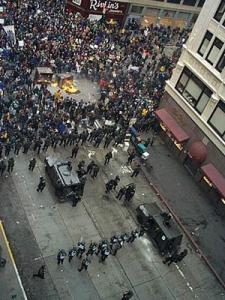
Seattle Protest

Seattle Protest

While the film itself focuses too heavily on the main characters story and not enough exactly on why it is that there even were protests, it does tackle important issues: for example the fact that the police are indeed the ones who started the troubles that week.  Aside from this and showing that labor was not alienated from the more “radical” protesters, the film really doesn’t offer much in terms of analysis of protest tactics or the overall strategy of anti/alter-globalizationists.  For example, the issue of violence during protests was only briefly addressed when a short scene that depicts an anarchist throwing something through a window when one of the main characters scolds them for the use of violence: the anarchist responds: that’s not violence!

While the issues of whether property damage can be violence or even terrorism is an important one that the film seems it is willing to tackle: it hardly addresses it.  It does, however, paint the main organizers in the film as ready to be arrested while they engage in direct actions like blocking major roads and convention sites which can certainly also be an important point of discussion for the left.  But overall, it seems to continue to play into certain stereotypes of leftists (at least anarchists) that are quite shallow.  There’s certainly a lot of debate to be had on whether the anarchist “black bloc” strategy is a valid one or not, but this film doesn’t seem to take that debate on.

The film ends with an inspiring positive montage of people resisting the WTO (and G20 I believe) all over the world since Seattle in 1999 which is perhaps a good way to inspire a newer generation of activists.  The film is worth the time to watch but has significant shortcomings for trying to tackle an important event in recent history for leftists .

Matewan (1987)

Matewan is a 1987 film directed by John Sayles. It deals with the Matewan Massacre (or the “Battle of Matewan”) when coal miners in West Virginia attempted to unionize and ran into significant resistance from the owners of the mines.  The film deals with themes of the division of the working class along racial lines, working class direct action, and capital’s resistance to worker organization.  Chris Cooper plays the main character who is a union organizer and former Wobblie.  He seems a bit disillusioned with the labor movement in its lack to truly form “One Big Union.”  He arrives in Matewan on the same train that was breaking in black strike-breakers to replace the striking miners when the train stops and he witnesses the black strike-breakers beaten by racists on the way to town.

Cooper's character gives an anti-racist speech

Cooper's character gives an anti-racist speech

Once he gets to town, he slowly tries to network and get in touch with the union where he tries to convince them to stand united with the workers coming to break the strike, while also convincing the strike-breakers that they ought not put the mine back in operation.  This drama is highlighted in a scene where the “leader” of the black strike breakers comes to a meeting of the union and demonstrates that he is “no scab.”  Cooper’s character gives a powerful speech denouncing the racism of the union and how workers need to stand together if they are to win their struggle against the company and the bosses.  The visiting workers who were brought in to break the strike decide to stand in solidarity with the original workers and eventually join the strike to add more pressure on the company and thus make the strike more effective.  This is what the rest of the film focuses on, the ongoing class struggle between the mine workers and the owners while the owners try various tactics of manipulating the workers (such as using agent provocateurs, lies, etc.) into defeat and ultimately fail (at least in the context of the film, historically the workers initially failed). The film ends with a major battle in the middle of the town that results in a few deaths, including Coopers character, yet the mood of the post-battle scene is that of optimism.

Where Sayles leaves this historical narrative off is of is incomplete with the actual struggles of mineworkers in WVA at the time. The “Battle of Matewan” lead almost directly to a larger, bloodier and more historically significant battle commonly known as the “Battle of Blair Mountain.” This battle involved the United Mine Workers of America who had been on strike and were involved with the Matewan incident and state and federal troops and is considered the largest labor uprising in US history (although it is not commonly taught in US schools). Sayles ends his story before this event took place, perhaps because he wished to leave on a positive note since the Battle for Blair Mountain resulted in a major defeat for UMWA. Although, many consider the labor laws passed in the 30s (and thus the resurgence of the labor movement) to be either directly or indriectly a result of the Battle of Blair Mountain, as the power that were in society at the time were backing the New Deal and attempting to avoid any sort of workers revolution (which at that time, was not an unrealistic possibility). Overall, Matewan is certainly a film worth watching as it portrays a chapter in US labor history that is often skipped over and forgotten.

Modern Times (1936)

Modern Times (1936) is perhaps one of the best examples of an American film that has strong leftist themes.  The entire film revolves around worker strikes, issues of the Great Depression, and I would even argue: an early critique of American consumerism (The American Dream).

The main character (the famous “Tramp”) goes through various difficulties in life throughout the film, including finding employment, arrest, etc.  Early on in the film, the capitalists in charge of the factory that the Tramp works in attempt to implement a way to manage lunch breaks more “efficiently” by introducing a machine that automatically feeds the worker to reduce the amount of time taken off by the worker for lunch.  This comedic scene highlights a classical problem with Capitalism: that of time management and exploitation.

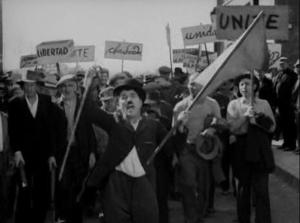
The Tramp accidentally leads a socialist march

The Tramp accidentally leads a socialist march

The Tramp also has a love interest in the film who also runs into employment problems throughout the film.  They eventually get a shack to live in that is falling apart, while at one point in the film they both dream of the typical “American Dream” house (that dream sequence seems to also be an appropriate critique of the the conservationism of the 1950s before its own time).

The two also at one point are in a department store enjoying the luxuries of being able to use everything in the store.  That fantasy sequence itself is a critique of consumerism and the constant promotion of consumer goods when workers (especially during those times) had a tough time having access to said goods.

Modern Times is an important critique of Capitalism and is itself a great film.

Novecento/1900 (1976)

Director: Bernardo Bertolucci

1900 is an excellent epic directed by Bernardo Bertolucci that takes place in early 20th century Italy (from around the turn of the century to about the end of WWII). The story revolves around two friends who grow up together, Olmo the farm worker and Alfredo the wealthy landlord (both of which inherent their status from their respective families).

Their relationship (along later with Sutherland’s) is essentially a long commentary on class struggle and fascism.  As Fascism is on the rise, Olmo and the workers actively oppose it while Alfredo, who doesn’t like Attila (Sutherland), takes little action.  The role of the fascist as a protector of property(and thus the capitalist class itself) is demonstrated through the relationship between the main characters.

The method of the film is quite successful, as the conclusions the directer wants the view to draw are quite obvious, yet drawing those conclusions can only come from experiencing the relative positions that the “main 3” go through and how they affect each other.

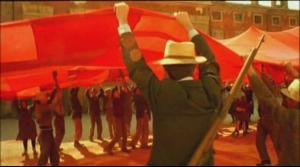
The relationships between Olmo and Alfredo are not simple either.  By the end of the film once fascism has been defeated by war, Olmo attempts to set up a “people’s tribunal” to judge Alfredo.  The crimes that Alfredo, as a land owner and employer of peasant labor, are not traditional crimes that would hold water in any capitalist system but are instead a recognition that the relationship in production between the two classes and how Alfredo’s class steals from

Workers raise their long hidden red banner

Workers raise their long hidden red banner

the workers and lives in luxury while they suffer is itself a crime.  The optimistic ending, however, doesn’t last long as the united front comes along and disarms the Communists in Olmo’s town, thus making them unable to finally retake power.  The film then ends with Alfredo and Olmo fighting each other for what looks like years (obviously Bertolucci is taking artistic liberty here), which in a sense represents the problem of compromise and how it left the system in tact and had prolonged the overall struggle.

The aesthetics of the film are also quite successful here, the scenes countryside and the towns are quite stunning and really help to set the mood of the film.  And like most Bertolucci films I’ve seen, the shots and sequences are quite slow paced and not always right to the point.  That is of course his style, and for this film, really does give it an epic feel.

The mood of the film itself is something that is expressed through the relationships built in the film as an allegory for political and class struggle.  It really does help to understand the rise and nature of fascism.  It’s quite long but worth the investment in time.