También la lluvia (2010)

English Title: Even The Rain

Director: Icíar Bollaín

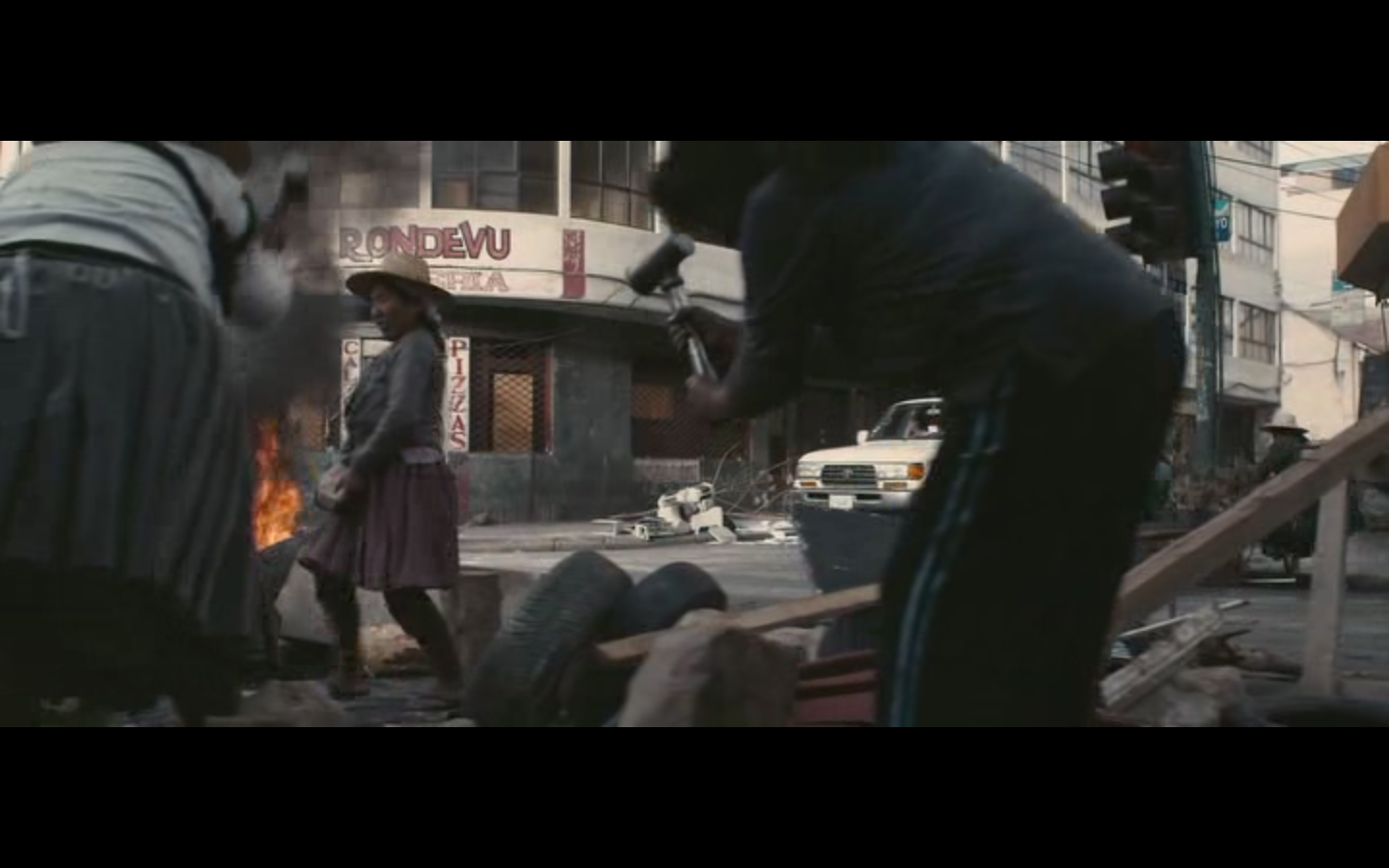
The set of the “film within the film”

Even The Rain is a film about the “Water Wars” of Boliva that took place in late 1999 and early 2000. The plot revolves around a director (played by Gael García Bernal) who is making a film about Christopher Columbus’ early brutal encounters with indigenous populations in the “New World.” This fictional film is depicted throughout Even the Rain as a parallel struggle to the water wars.

Instead of just framing the problems of water privatization and issues of global capital, Even the Rain is as much a film about the actual resistance to those attempts by capital than it is just about the process of (foreign) capital’s attempts to acquire basic resources like water. Throughout the film, one of the main actors hired for the “film within the film” is a leading activist against the water privatization who also plays one of the main ingenious figures who resisted the violence  brought onto indigenous peoples by Christopher Columbus. This perspective of the film provides voice to the resistance to such measures by global capital in ways that go beyond telling the story of globalization as a story of victimizers and victims and instead gives agency to those who are part of the process and attempt to challenge the process itself.

The revolt

The film opens with a nod to Howard Zinn, whose style of telling history from the eyes of the oppressed is quite clear in the film through the use of the “film within the film” to depict the parallels of the struggles of the past as similar to contemporary struggles. The complexities of oppression are also present in the film, for example a scene in the car of the filmmaker includes a conversation about language and privileged (an argument breaks out about not filming in English, which would have made more money, and the lack of presence of indigenous language).

The main event of the film, or climax, revolves around a revolt in the city of Cochabamba. This famous event eventually helped lead to the ascendency of the Evo Morales government to power. The revolt is certainly portrayed in a positive light (which even emotionally affects some characters who had clearly been skeptical to the demands of the local residents).

Overall, the film has an important message of social justice, and is a cinematic achievement in itself. It does an excellent job at capturing a revolutionary period while at the same time avoiding cinematic cliches about such struggles.

Les Noms des Gens (2010)

This post was submitted by Anna Lekas Miller who is a writer for Alternet

Director: Michel Leclerc

English Title: The Names of Love

So, France has a new president.

In a close election, François Hollande, of the French Socialist Party, defeated the infamous Nicolas Sarkozy. There were many symbolic moments—instead of celebrating in Paris’s Place de la Concorde, as Sarkozy’s supporters had the year before, Hollande’s supporters gathered to rejoice at the other end of the city at Place de La Bastille—the historic site of the French revolution and the numerous social movements, general strikes, protests, marches and celebrations that have characterized the French Left ever since.

François Hollande is part of a growing electoral theme in Europe—tired by austerity measures, and the successive, costly bailouts, the results at the polls are swinging towards the (politically palatable) left.

But will the election of a socialist president translate to a socialist re-configuration of society, where wealth is radically redistributed, bailouts that save the asses of the elite while sacrificing the well-being of the people are off the table, and everyone—immigrants, nationals, bourgeoisie and working classes—lives in harmonious, indistinguishable equity?

Probably not.

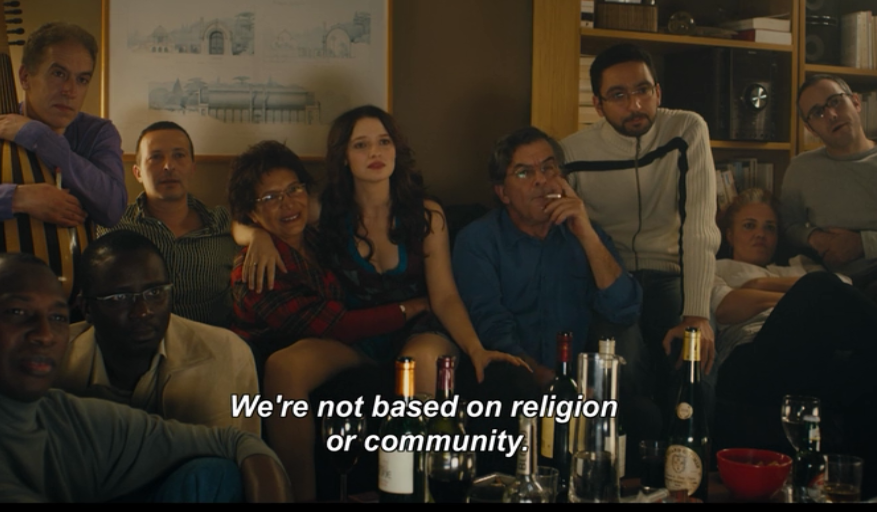
Instead of sorting through twitter, and trying to find the balance between the cynics who see a reflection of Barack Obama’s unfulfilled promises in François Hollande and my French friends surrounding me celebrating the end of Sarkozy, I decided to do what any sensible, politically-engaged woman trying to make sense of the left would do on the night of a significant election. I opened a bottle of red wine, lit some candles and watched my favorite French movie in the world, Les Noms des Gens for what has to finally be the ten millionth time.

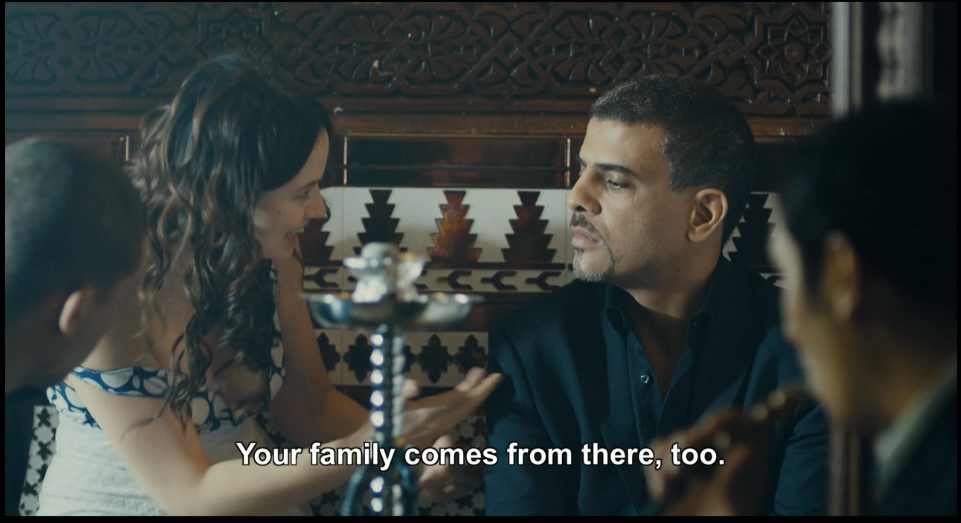
Les Noms des Gens—translated as “People’s Names”—is a love story based in French identity politics. It opens with Arthur Martin, an ordinary and at first mundane man who makes his living doing autopsies on dead geese. He is predictable, and as his name might imply, comes off as very classically and comfortably French.

Quickly, the camera cuts to Baya Benmahmoud—his polar opposite. She is young, vivaciously sexual and rabidly outspoken, and as she says, “No one in France shares my name.” She is half-Algerian, and half French—and like many French children of Algerian immigrants, struggles with reconciling her white skin and French appearance with her disgust towards racism, colonialism, and the treatment of immigrants.

She has an unabated adoration of the left—which she displays through only sleeping with right-wingers with the sole purpose of converting them to the left.

“When I say I fuck them, I really do,” she says, while explaining her practices to Arthur. “Someone from the Front National takes about ten days. But a centrist, he can be converted in an afternoon.”

Gradually, the two polar opposites begin to fall in love—but not without hilarious moments of political differences punctuating their relationship. In one scene, Baya’s ebulliently leftist mother tries to convince Arthur to marry one of her friends for her citizenship. In another, Arthur tells Baya all the topics of conversation that she must avoid when she meets his parents. Exasperated, she blurts out,

“So what are we supposed to talk about? The weather?”

“Yes! That is perfect!” he replies.

Baya finds out that Arthur is actually Jewish—and his mother’s family experienced the genuine suffering of the Holocaust. She falls even more deeply in love with him.
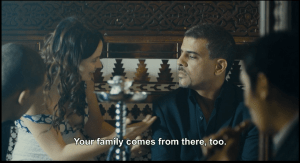
“This is great,” she says as they are sitting at a bar, “I am Arab, and you are Jewish! Together we are two forgotten pieces of France’s history. We wont have true world peace until we are all mixed.”

In a flurry of personal emotions, Arthur suddenly decides to cut things off with Baya. The relationship has become too serious, and he fears that Baya is making too many waves in his once quiet, predicatable life. However, life without Baya—and her unabated adoration of all that makes the left and how she manifests this in her daily actions—is a dull life. There is no one to hold the subway doors open while an elderly couple struggles to make the train, no one to save the crabs at the market place from being eaten, and no one to blame everyone who doesn’t ardently adhere to the left for being a fascist.

Also, there is far less sex.

In the end, the two lovers reunite—this time when they are at the polling place together, Baya is very pregnant. At one point, she looks down and realizes that she accidently voted for Sarkozy. Her blood curdling screams cut to her in the hospital in labor, giving birth and looking at the TV in horror as Nicolas Sarkozy is elected to La Marseillaise.

“His name?” the nurse asks

“Chung. Martin. Benmahmoud” they say

“His background?”

“His background, we don’t care,” the two reply, smiling at one another.
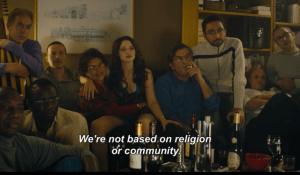
Baya would have celebrated in the streets when François Hollande was elected—but will he really be the leader that the left wants to see transform France? Perhaps the deregulation and austerity measures started under Sarkozy will be halted and curbed, but the racism, anti-immigrant sentiment and remnants of a colonial past that still plague France, and the many different types of people who make up France won’t be washed away overnight. These aspects of French culture—or any culture—are ingrained in the history, in the family tree that traces its French origins back to the 1500s and in the awkward dinner conversations where a daughter brings her Algerian boyfriend home to meet her father who had also been in Algeria for “different reasons.”

It’s in the streets and the schools, the micro-aggressions and conversations that dictate whether one population feels tolerated or welcomed far more than political parties or policies. It’s in the unlikely friendships and relationships—and, as more and more opposites make love and create a new generation of multiple identities, differences become less distinct and more celebrated and, as Baya says, as our identities mix and mingle we get a little bit closer to world peace.

So, I’m not so sure that an elected leader—especially one who despite his socialist label seems ready to pander to neoliberalism, and doesn’t seem to have anything particularly radical to say about anything—will change France, or any country for that matter. But maybe the people—through meeting one another, sharing stories, being frank about their identity politics, opening each others minds through personal relationships, and making lots and lots and lots of love just might.


The Edukators(2004)

The following review was written by Kate Devlin

Director: Hans Weingarnter

The title in German has been translated both as “The Fat Years Are Over”, a phrase from the German Luther bible, and “Your Days of Plenty Are Numbered”. The film stars  Daniel Bruhl as Jan, Stipe Erugen as Peter, and Julia Jentsch as Jule.

Cabin where the hostage is held

This film concerns three young leftist activists living in contemporary Berlin. The character’s lives are introduced in the opening scenes showing them to be active in anti-corporate protests. For example, one scene shows activists at an anti-sweatshop protest, disrupting a shop selling high priced sneakers made by sweatshop labor.

Jule is financially “up against it,” working in a low paid job as a waitress, serving meals to wealthy customers who are often arrogant and abusive towards her. One evening at work, after an evening of abuse from both customers and her boss, Jule takes a break and chats with a male co-worker, who himself as been previously reprimanded by the boss. Unfortunately for Jule and her co-worker, this happens to be a busy time for the restaurant. When the boss sees his employees doing what he regards as “goofing off” he flies into a rage and fires both of them.

She is soon after evicted from her apartment for paying her rent late. And although this is set in Berlin in 2004, Jule’s situation is easy for contemporary young people in the US to identify with and reflects the predicament of many young people in the US; saddled with un-payable student loans and stuck in low level, dead end service sector jobs famous for abusive working conditions.

While Jule and Jan are painting, they develop a friendship. Soon after Jule ends up accompanying him in his and Peter’s van. Jan tells Julia what he and her boyfriend really do at night. Instead of posting advertising signs around Berlin they are the “Edukators”, anarchists who have gained publicity by breaking into wealthy people’s houses, rearranging furniture, and putting up signs saying, “You have too much money.” Jan explains this as their form of activism. They educate the wealthy ruling class in the dangers of having too much money and educate radicalizing youth and the working class to struggle against capitalism. Jan explains that he feels that an anti-capitalist revolution will occur in the near future.

They then break into the house of someone Jule indebted to. Jule is amazed at the lavishness of Harding’s home, a vast contrast to her and her friends squalid surroundings .She appears emotionally mixed, in this scene and though out the movie. She hates the rich, the stranglehold they have on society and the denial of opportunities to those not in the ruling class. At the same time she is adamant in her pacifist beliefs of strict non-violence and in not stealing property from Harding’s house. Jan is not as strict in these beliefs and there is a debate between the two.

A few days after the break in of Harding’s house Julia realizes she has left her cell phone there. She tells Jan. Together they plan another break in to retrieve it. It takes them quite some time to find the phone. Shortly after the phone is located Harding unexpectedly arrives home. He is seen talking on his phone to his wife explaining the details of why he ended his vacation early. Through a frantic reaction of how to act, they decide to kidnap Harding.

Most of the remainder of the film takes place at the cabin located in the Austrian Tyrol. At first Jan, Jule and Peter are hostile and mistrustful towards Harding. They are also unsure of what to do next. They seriously discuss “going for broke,” carrying out an attack on a TV tower as an anti-capitalist gesture. They have discussions about capitalism with Harding. The three young people see the capitalist system as being inherently exploitive and based on greed. Harding seems to believe in a meritocratic system in which success is the result of hard work and having creative ideas. Jule mentions how sweatshop workers in the Third World are left out of this “meritocracy” “What about their good ideas?” she asks.

The anti-capitalist points  raised by the three young  people are interesting but somewhat maddening from a more Marxist perspective. Their anti-capitalism seems to be based on moral grounds and they do not appear to have a theory of the underlying workings of capitalism or what an alternative to it may be like. The film of course was made four years before the current economic crisis and reflects a milieu which did not fully understand Marxist or other leftist economic critiques. The attitude and earnestness of the three is to be admired however.

During an early discussion Jule mentions the fact that the debt she incurred though her accident ruined her life. Harding tells the three, to the effect that, “you should have told me, we could have worked out something.” Harding’s wealth and seeming obliviousness to the situation of those less privileged and lack of social consciousness do not make him sound convincing though.

The rearranged furniture

The three anarchists and Harding very gradually warm up towards each other.  One time they begin talking after a joint is past around. Harding tells the three that he had once had similar beliefs as they do. It turns out he had been in the leadership of the German SDS (Socialist German Student Union), a 60s/70s organization somewhat more radical than the US group of the same acronym, and had been personal friends with Rudi Dutschke and other well-known activists of the German New Left. The four of them discuss leftist lore and the history of the German New Left. While the attitude of the three towards Harding is still wary, they loosen up towards him after this.

Harding describes how he gradually changed his leftist philosophy. He says “when you first buy a new car, you feel guilty. Then you find you gradually make other changes.” He describes a process of gradually fist accommodating to and then embracing capitalism as a way of life. Musing while he and Jan are chopping wood and doing outdoor tasks, Harding appears to rethink his life, saying he is sick of the corporate world and longs for a simpler life in the countryside.

Harding makes a deal to not call the police if he is released, and the activists agree. The concluding scenes show Julia, Jan, and Peter sleeping together in a large bed. Anti-terrorist police are shown clammering up the stairs. It appears that, predictably from a Marxist view that “conditions produce consciousness” that Harding, back in his comfortable home, has gone back on his promise. The film ends with an interesting twist.

Overall this is an excellent film. The conditions facing many of today’s youth, especially those in their 20s though out much of the developed world are movingly shown. The film also shows the differences and continuities between the struggles of the original New Left 60s/70s generation and those of radicalized youth today. The film reflects an anarchist viewpoint which relies more on individual anti-capitalist activism and education as methods of struggle. Most Marxists would favor activism based on helping workers increase their level of class that is moving people through struggle, of an understanding that their interests are different from that of the ruling class and those who own capital.

According to Wikipedia in 2009 a statue was stolen from convicted swindler Bernie Madoff was returned with a note that read “Bernie the Swindler, Lesson: Return stolen property to rightful owners”. It was signed “the Educators”.

Harlan County, USA (1976)

Director: Barbara Kopple

This academy award winning documentary is itself an important contribution to the 20th century working class movement of the United States.  While it not only played an important role in documenting a violent struggle for unionization in Kentucky, the presence of the film crew was itself cited in helping achieve victory for the miners who were the subject of the film.

As with many cases of violent struggle with attempted unionization in coal mines, Harlan county was one where company thugs, workers, and police all played an all too cliche role. Thugs and police helped (with the interesting exception of the complex role of the Sheriff) maintain the company’s power while the workers had to face legal challenges, attempted murders, and intimidation to form their union. This familiar narrative is not only the result of the same struggle taking on a similar form various times throughout American history, but the film itself inspired other films, for example Matewan. (John Sayles on Harlan County)

The most striking thing about the case of Harlan County is how similar the film’s structure is to that of the various other films/narratives about unionizing efforts in other coal mining areas that date back to the late 19th century. The exception in this case, however, is a demonstration of some serious corruption at the union level. While the story of the drive itself is familiar, one significant difference is that this was not the beginning of the United Mine Workers of America but rather that there had been decades of development for that organization. There is even a case where a rank-and-file candidate runs for the presidency of the union and is murdered by folks connected to what is perceived as the corrupt leadership.

These struggles demonstrate the real problems that go into organizing that is not simply a romanticized version of “the workers vs the bosses” but rather demonstrate the complexities. The “labor aristocracy” is shown to be quite clear in this film and the future of the union is questioned even with the optimistic overtones towards the end of the film and victory of the particular drive. Some of the members remain quite unsatisfied with the contract that they won, for example.

Further reading: http://www.criterion.com/current/posts/422-harlan-county-usa-no-neutrals-there