If you like the posts of the Left Film Review and want to stay updated, follow us on Facebook where we post new reviews as they come out.
http://www.facebook.com/pages/Left-Film-Review/161849977186797
If you like the posts of the Left Film Review and want to stay updated, follow us on Facebook where we post new reviews as they come out.
http://www.facebook.com/pages/Left-Film-Review/161849977186797
Jon Spaihts, a screenwriter for the recently released film Prometheus, recently wrote an article for the Wall Street Journal titled “Can Sci-Fi Relaunch the Space Program?” In it, he details the relationship that science fiction has had and can have to space exploration. He details how space travel “originated” with the Cold War and how the “space race” helped to produce a rich volume of science fiction that was tied to the competition between the USSR and USA.
In a way he romanticizes the Cold War, which is not dissimilar to many academics and pro war politicians who long for the days of clear national competition and what they see as an easier appeal to patriotism (in other words: having the big Other to remind the public to fear). Spaihts’ brief history of science fiction here leaves out important historical ties between SciFi and space programs, most notably the “Star Wars program” (see the role of The Citizen Advisory Panel on National Space Policy where SciFi authors were encouraging the implementation of the military program).
Many on the Left and the Right want to see a sort of space exploration, but what kind of space program does Jon Spaihts want to see revived? Aside from the end of the article where he is implicitly promoting space tourism as a potentially exciting new trend for rich folks who have always dreamed of space, the most telling phrasing is when he discusses trends in SciFi:
Although these trends are cloudy, one can argue that in the last fifteen years the space epic has fallen from favor, as sci-fi films have concerned themselves more with cyberpunk scenarios and Earthly dystopias than travel between the stars. As if our culture as a whole had turned its eyes away from external adventures to internal struggles.
So in essence, he sees the “internally looking” science fiction sub genre of cyberpunk as problematic and is advocating for a more outward and escapist space exploration style of the genre. We can certainly see this in Prometheus: a rich corporate boss wants to fulfill his life by funding a trillion dollar space ship to discover the meaning of life. While the film does not necessarily promote this sort of expansionist ideology, nor is it as much of a critique or warning against the corporate lust for profits in space as we find in earlier influential Scott films like Alien. This is problematic for science fiction: the ignoring of the internal contradictions that genres like cyberpunk offer in favor of “outward looking” space exploration stories that move our attention from real struggle to a dream of future prosperity and wonder (which is interestingly very similar to the “American dream” itself).
It would be interesting to hear Ridley Scott’s take on this question, considering he was not only the director of Prometheus but of perhaps the most influential cyberpunk film of all time Bladerunner which is a clear “inward looking” science fiction critique of a future ruled by corporate power.
Directors: Pan Wenzhan, Fu Jie

The Women's Detachment
The Red Detachment of Women is a film adaptation (or rather filmed version of) of a Chinese ballet from the mid 1960s. It was produced during the Cultural Revolution in China, which itself made quite an impact on the Western Left (and particularly in the French Left).
The film (and ballet) follows a poor peasant named Wu Qinghua who goes from being imprisoned by her landlord for being in debt through her escape and journey to become part of the Red Army. Throughout the film, she receives training from the Red Army as they prepare to assault the landlord class’ stronghold.
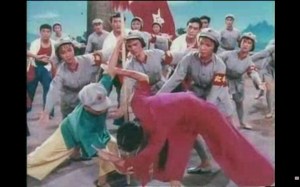
The scenes that depict the Red Army are usually filled with upbeat music and show a joyful cadre willing to fight for the cause. This is reminiscent of classic “Stalinist” films such as Circus (1936) where “joy” is part of every day life and how that every day life relates to the state. In the case of Detachment, these scenes are contrasted with the elite, who are depicted as a classic “bad guys.” An interesting example to highlight how the Red Army is portrayed, when Wu Qinghua enters the camp and falls down, the entire army physically moves down to prevent her from falling; while this is perhaps an exaggeration in analysis due to this being a ballet performance it still shows how the “ideology” is supposed to come through. Criticisms of “binary contrasts” and oversimplification aside, this makes for a plot device that highlights class struggle, and more importantly: the role of women in that struggle.

Red Army helping Wu Qinghua
Throughout the film, women are portrayed as a fighting force, from their training to actual combat (where they take leadership roles as well). This is contrasted with the landlord from the beginning of the film who imprisoned women who owed him debt, and the “tyrant’s” lair, where women were subjected to male rule. While this is all through the lens of the Red Army (and thus the Party) as a whole, it demonstrates the interconnectedness of the two struggles, or at least an attempt to connect the two struggles in this context.
Although the film did have this positive portrayal of women as agents of change, the “hero” of the film who was made a martyr towards the end is a male character. While this makes the film a bit more complicated in terms of portrayal of gender, the film itself still stands as an example of linking the struggle against property and the struggle for women’s liberation (which at the time of this film was an ongoing struggle).
At the time of this writing, the film can be seen in its entirety on “The Internet Archive”
There are also various clips of the film on YouTube
Perhaps even more important than the film itself is the geopolitical implications of this Oscar win and the acceptance speech: Asghar Farhadi, director of A Separation, implicitly denounced the growing tensions between the United States and Iran. It seems to have been received better than Michael Moore’s anti-war speech during the Iraq war.
I proudly offer this award to the people of my country, the people who respect all cultures and civilizations and despise hostility and resentment.
The Speech can be viewed at 1:25:
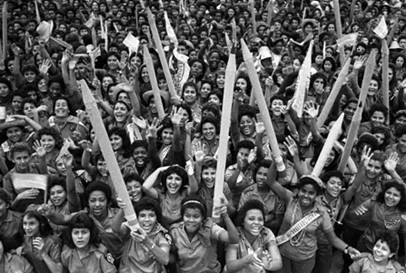
The Cuban literacy campaign began 51 years ago this month. This was an important moment for the Cuban revolution that would help set Cuba apart from the rest of the Caribbean. This is a review of a documentary about that campaign.
The following is re-posted with the permission from the author and originally appeared here
Freedom Through a Pencil: The 1961 Literacy Campaign in Cuba
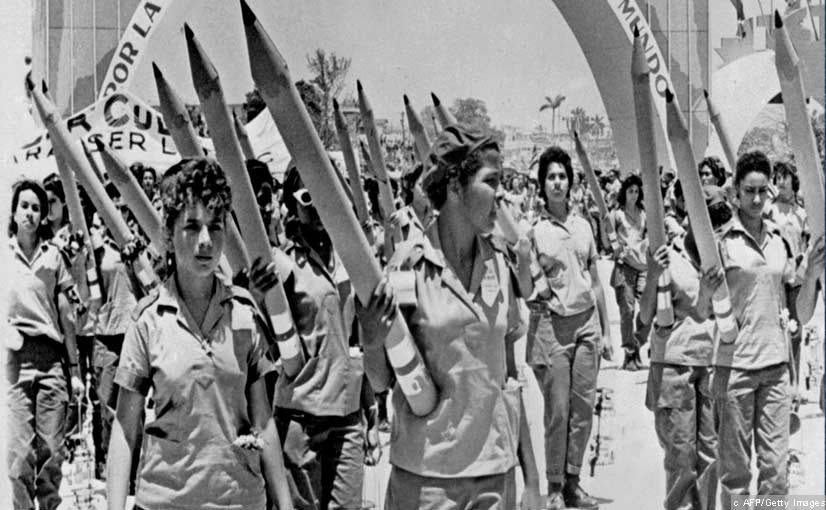
by Sujatha FernandesThe high rate of literacy in Cuba is one of the proud and much touted accomplishments of the Cuban Revolution. Beginning half a century ago, in 1961, the literacy campaign mobilized more than 1 million Cubans as teachers or students. In that same year, 707,000 Cubans learned how to read or write. Maestra tells the story of that inspiring campaign through the memories of the women who served as literacy teachers—the maestras themselves.
The filmmaker, Catherine Murphy, lived in Cuba in the 1990s and earned a master’s degree at the University of Havana. She is the founder and director of a multimedia project known as the Literacy Project, which focuses on gathering oral histories of volunteer teachers from the literacy campaign. For Maestra, the first documentary to arise from the project, she interviewed more than 50 women and 13 men who were involved in the campaign. Many of them are now in their seventies. She also carried out five years of research in the Cuban national film archives.
Documentary footage shows the energy and enthusiasm of the young women who traveled on trains into the small towns and countryside of Cuba to live among the people and teach them how to read and write. But the challenges they faced were extreme. These women often faced opposition from their families, and many left against their parents’ wishes. They lived with poor rural families, sleeping in hammocks at night. During the day they would work in the fields alongside the peasants, and in the few hours they had in the evening, they would prepare lessons and conduct classes.
The hardships and poverty they encountered were not always conducive to learning how to read and write. Literacy teacher Diana Balboa recounts the story of a 47-year-old palm tree cutter: “His hands were swollen and deformed by such a violent job. He was unable to hold a pencil. I helped him hold the pencil but it fell out of his hands.” The man learned to read a bit, but he was never able to write.
In the midst of the literacy campaign, Cuban exiles launched the CIA-supported Bay of Pigs invasion. Although it was discovered and thwarted by the Cuban armed forces, escaped mercenaries combed the countryside, harassing the peasants and their literacy teachers.
In a country where the urban and rural poor had long been denied access to education, literacy was empowerment. For the counter-revolutionaries who wanted to see Cuba return to the status quo, teaching literacy to the poor was an affront to the class order. One teacher recounts the threats to her host family from gunmen who pounded on their door, demanding, “Bring out the literacy teachers!” But this family, like others across the country, put their lives on the line to protect the teachers. Sadly, they were not always able to escape these threats, and one teacher, Manuel Ascunce, was killed by insurgents.
As the literacy teachers recount, the campaign broke taboos, particularly around gender. Young women in general were subject to the norms of patriarchy. They were not expected to excel at their studies. They were confined to the house, and their futures were limited to what their parents decided for them. Being part of the literacy campaign helped these young women break away from parental constraints. For Norma Guillard, going on the campaign at the age of 15 was an adventure. It was her first time away from home, and it gave her a feeling of freedom and independence.
The film shows how the literacy campaign not only promoted literacy, but also profoundly changed the lives of the maestras themselves. Upon returning from the campaign, they were given scholarships to continue their studies. Guillard signed up immediately. As she recounts, “I had become used to moving around and being independent.” She eventually trained as a psychologist. Another maestra became a mathematics teacher. These professions were rare for women in the pre-revolutionary order.
In the documentary, we are reminded of the major milestone that Cuba achieved in such a short time. One of the most touching moments is the footage of a man who writes his name on a blackboard in slow, deliberate cursive strokes while a teacher watches from the side. When he finishes he stands in front of his completed name: Pablo Benitez. He has a quiet, proud smile on his face.
The literacy campaign is vitally important to revisit today, given the global challenges of illiteracy. We often think of illiteracy, particularly in Western nations, as a problem eradicated years ago, along with smallpox. But according to UNESCO, about 1 billion people—or 26% of the world’s adult population—remain non-literate. While developing countries have the highest rates of illiteracy, Western developed nations also have surprisingly high rates. A study carried out in 1998 by the National Institute for Literacy estimated that 47% of adults in Detroit and 36% in New York City were Level 1 readers and writers, meaning that they “could perform many tasks involving simple texts and documents,” such as signing their names or totaling a bank deposit entry, but could not read well enough to, “fill out an application, read a food label, or read a simple story to a child.”
Maestra is a compelling and beautifully filmed reconstruction of one of the most significant campaigns in Cuba’s history. Fifty years on, the film clearly demonstrates the impact that it had on the lives of all those who took part.
So far, this site has focused mainly on narrative fiction films. This of course leaves out a major section of films that are of great interest to the Left: documentaries. Posts here tend to sum up films and do a small amount of analysis when possible of these films. Doing the same with documentaries may be a little redundant, so the posts on documentaries will tend to be shorter: sort of a collection of highlighted documentaries, what they’re about, why they’re of interest to the Left, and why you should check them out.
I will add a documentary a day for the next few days, thus starting the first Documentary a Day series at Waiting for Lefty with Cuba! Africa! Revolution!
There is already a blog that deals with leftism in film: http://www.socialistfilms.org/ so why another site?
Firstly, it seems that the socialist films site has gone dormant and hasn’t been updated in some time, and many of us would like to see a continuation of the exploration of films from socialist countries to expose them to an audience who may not have otherwise been able to know about the films (and even if they can’t view the films easily, they can at least learn about them).
Secondly, the socialist film review site is focused on films from socialist countries specifically and does not include socialist/leftist films from other countries. There are many films that deal with socialism and leftist themes that come from places like the West that are also worth exploring and dealing with for a blog about socialism in film. So in a sense this blog can be seen as an attempt to continue the work of socialist film review and to expand its original scope.