Modern Times (1936)

Modern Times (1936) is perhaps one of the best examples of an American film that has strong leftist themes.  The entire film revolves around worker strikes, issues of the Great Depression, and I would even argue: an early critique of American consumerism (The American Dream).

The main character (the famous “Tramp”) goes through various difficulties in life throughout the film, including finding employment, arrest, etc.  Early on in the film, the capitalists in charge of the factory that the Tramp works in attempt to implement a way to manage lunch breaks more “efficiently” by introducing a machine that automatically feeds the worker to reduce the amount of time taken off by the worker for lunch.  This comedic scene highlights a classical problem with Capitalism: that of time management and exploitation.
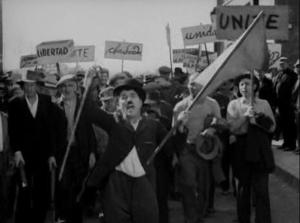
The Tramp accidentally leads a socialist march

The Tramp accidentally leads a socialist march

The Tramp also has a love interest in the film who also runs into employment problems throughout the film.  They eventually get a shack to live in that is falling apart, while at one point in the film they both dream of the typical “American Dream” house (that dream sequence seems to also be an appropriate critique of the the conservationism of the 1950s before its own time).

The two also at one point are in a department store enjoying the luxuries of being able to use everything in the store.  That fantasy sequence itself is a critique of consumerism and the constant promotion of consumer goods when workers (especially during those times) had a tough time having access to said goods.

Modern Times is an important critique of Capitalism and is itself a great film.

Novecento/1900 (1976)

Director: Bernardo Bertolucci

1900 is an excellent epic directed by Bernardo Bertolucci that takes place in early 20th century Italy (from around the turn of the century to about the end of WWII). The story revolves around two friends who grow up together, Olmo the farm worker and Alfredo the wealthy landlord (both of which inherent their status from their respective families).

Their relationship (along later with Sutherland’s) is essentially a long commentary on class struggle and fascism.  As Fascism is on the rise, Olmo and the workers actively oppose it while Alfredo, who doesn’t like Attila (Sutherland), takes little action.  The role of the fascist as a protector of property(and thus the capitalist class itself) is demonstrated through the relationship between the main characters.

The method of the film is quite successful, as the conclusions the directer wants the view to draw are quite obvious, yet drawing those conclusions can only come from experiencing the relative positions that the “main 3” go through and how they affect each other.

The relationships between Olmo and Alfredo are not simple either.  By the end of the film once fascism has been defeated by war, Olmo attempts to set up a “people’s tribunal” to judge Alfredo.  The crimes that Alfredo, as a land owner and employer of peasant labor, are not traditional crimes that would hold water in any capitalist system but are instead a recognition that the relationship in production between the two classes and how Alfredo’s class steals from

Workers raise their long hidden red banner

Workers raise their long hidden red banner

the workers and lives in luxury while they suffer is itself a crime.  The optimistic ending, however, doesn’t last long as the united front comes along and disarms the Communists in Olmo’s town, thus making them unable to finally retake power.  The film then ends with Alfredo and Olmo fighting each other for what looks like years (obviously Bertolucci is taking artistic liberty here), which in a sense represents the problem of compromise and how it left the system in tact and had prolonged the overall struggle.

The aesthetics of the film are also quite successful here, the scenes countryside and the towns are quite stunning and really help to set the mood of the film.  And like most Bertolucci films I’ve seen, the shots and sequences are quite slow paced and not always right to the point.  That is of course his style, and for this film, really does give it an epic feel.

The mood of the film itself is something that is expressed through the relationships built in the film as an allegory for political and class struggle.  It really does help to understand the rise and nature of fascism.  It’s quite long but worth the investment in time.

Salt of the Earth (1954)

Director:  Herbert J. Biberman

Salt of the Earth (1954) is somewhat of a rarity in American cinema.  It is often described as the “only film banned/blacklisted” in the United States.  (This of course doesn’t take into account certain foreign films like Battleship Potemkin, that also were essentially blacklisted in the same way).  The history of the film itself is unique as it was made by one of the “Hollywood Ten” blacklisted directors and contains strong pro-Socialist, pro-Feminist, and anti-racist themes.

The film itself revolves around the struggles of Mexican and Anglo miners who decide to go on strike and how that strike is dealt with by the state and the company they work for.  The union votes to strike through a thoroughly democratic process.  The problems of leading up to the strike include the same problems like the film Matewan had: racism and division (I would even imagine that Matewan drew much inspiration from the themes dealt with in Salt of the Earth).

The miners confront the bosses

The miners confront the bosses

Once the workers are actually on strike and have established that they need to stay united, the striking miners’ wives and significant others call to their attention the way in which the miners have been sexists to them and demand to be treated as equals.  There is even a meeting where some of the union workers attempt to block the women from participating in decision making when the women decide that they want to help on the picket line.  The men are called out for being “overly protective” and sexist in their position that the line is “no place for women” and eventually the men concede and the women are allowed to participate.

This unity that is ultimately established in the film was key for the success of the strike, as the powers that were attempted to prevent the strike from continuing, they could not face a united working class of the film: and that is the overall message of the film.  The brilliant thing about the film is that the divisions in the working class were not presented as this “top down” trickery by the ruling class to divide the working class where the workers are portayed as drones easily duped by capital, but instead that the workers approached the situation with their own flaws and that

only they could get over them.  The divisions were certainly shown to be an advantage for the bosses, and one can of course trace those ideas and ideology to the ruling elite, but that blame can only go so far and this film does a good job at painting a more realistic picture.

As a matter of fact, most of the actors of the film aren’t actors at all, as the film uses neo-realism as a technique to deliver what the filmmakers saw as the most realistic portrayal of such an atmosphere possible.  Overall, the film is quite successful in what it tries to do: make a case for working class unity in the face of the class struggle.  It’s an important film in American cinema and is all too often overlooked.

Posted in USA

What this site is

There is already a blog that deals with leftism in film: http://www.socialistfilms.org/ so why another site?

Firstly, it seems that the socialist films site has gone dormant and hasn’t been updated in some time, and many of us would like to see a continuation of the exploration of films from socialist countries to expose them to an audience who may not have otherwise been able to know about the films (and even if they can’t view the films easily, they can at least learn about them).

Secondly, the socialist film review site is focused on films from socialist countries specifically and does not include socialist/leftist films from other countries. There are many films that deal with socialism and leftist themes that come from places like the West that are also worth exploring and dealing with for a blog about socialism in film. So in a sense this blog can be seen as an attempt to continue the work of socialist film review and to expand its original scope.